PR and SEO in 2026: Why They Now Share the Same Goal
PR and SEO used to follow different roads. PR built reputation and relationships. SEO built rankings and backlinks. Different teams, metrics and briefs, until now. The rise of AI search has changed things, and the two now share a single objective: building the digital authority that search engines and AI platforms use when deciding which sources to trust, cite and surface.
Key takeaways
PR and SEO now share a common goal: establishing digital authority that AI systems recognise and reward
AI search rewards credible, clearly attributed, third-party-validated content, which is exactly what PR produces
Unlinked brand mentions carry search value alongside traditional backlinks, making every piece of earned coverage more strategically important
The E-E-A-T framework (Experience, Expertise, Authoritativeness, Trustworthiness) that Google uses to evaluate content rests on the same signals PR has always generated
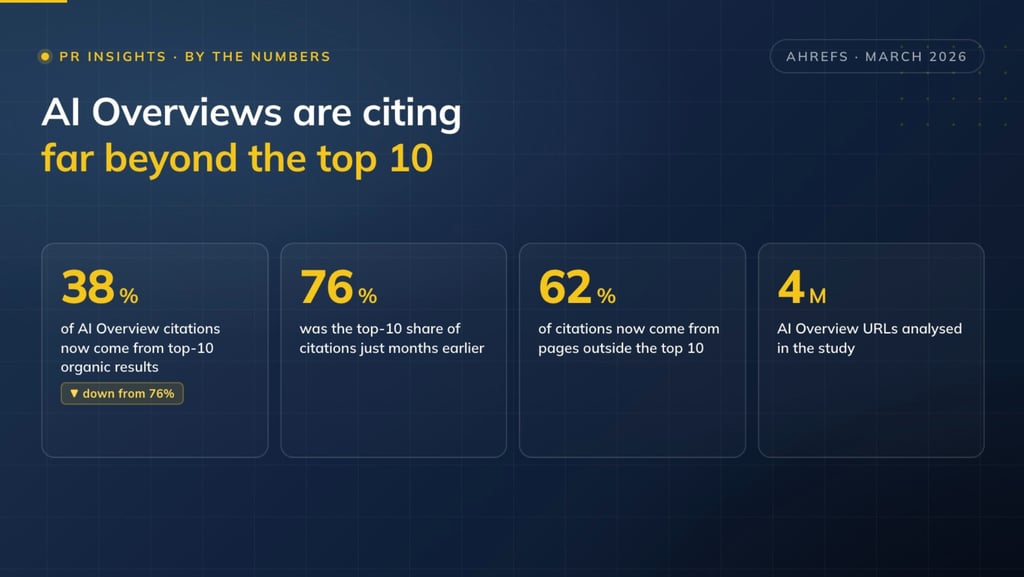
According to Ahrefs, only 38% of citations now come from pages in the top 10 organic results, down from 76% in mid-2025. Topical authority across the web matters more than ranking for any single keyword
The Q4 2025 IPA Bellwether report marked the tenth consecutive quarter of rising PR budgets, while overall marketing spend flatlined
The common goal
Digital authority is how your brand is perceived across the web in terms of expertise, authority and trustworthiness. The stronger your standing, the more likely search engines and AI platforms are to draw on your content, quote your experts and recommend your brand.
PR is one of the most powerful tools available for building trust and authority. Organisations that keep public relations and SEO separate are falling behind those that have them connected.
What changed and why it matters
Optimising page structure, researching keywords, building links and tracking rankings. That’s the backbone of traditional SEO, and though still important, it has never been less sufficient on its own.
Google's algorithms now use natural language processing, machine learning and contextual understanding to evaluate not just whether a page contains the right words, but whether the brand behind it is genuinely credible.
The E-E-A-T framework (Experience, Expertise, Authoritativeness and Trustworthiness) shapes how Google assesses content quality, and every one of those signals is influenced by PR activity.
Keyword-optimised content without genuine authority behind it will underperform as AI systems become the primary layer through which audiences encounter brands, because those systems rely on credibility signals rather than keyword density.
How PR builds the signals SEO and AI search needs
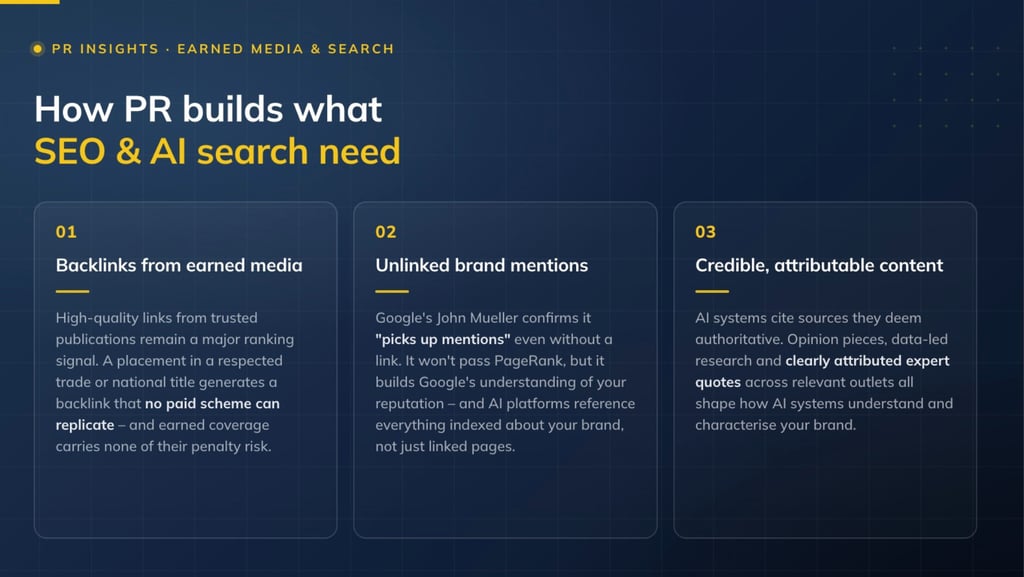
There are three specific ways that PR feeds search and AI visibility.
Backlinks from earned media: High-quality links from trusted publications remain a significant ranking signal. A placement in a respected trade publication or national title generates the kind of backlink that no paid scheme can replicate, and those schemes carry growing risk of penalties. Earned coverage is the legitimate, sustainable route to a strong backlink profile.
Unlinked brand mentions: A mention without a hyperlink is not a wasted placement. Google has confirmed that it picks up mentions on another website regardless of whether a link is present. These are known as ‘implied links’. Though an unlinked mention does not pass PageRank in the same way an actual link does, it contributes to Google's broader understanding of your brand's reputation. In the context of AI search, this matters even more. AI platforms reference the full body of content indexed about your brand, not just pages that link directly to your site.
Credible, attributable content: AI systems cite sources they deem authoritative. PR generates the third-party validation, expert commentary and independently published content those platforms use when constructing answers. A well-placed opinion piece, a data-led research report covered by multiple outlets or a series of clearly attributed expert quotes across relevant publications all contribute to how AI systems understand and characterise your brand.
The AI Overview citation picture and what it means for PR
For a long while, the headline finding from most research was that the majority of AI Overview citations came from pages already ranking in the top 10 organic results. That was broadly accurate in mid-2025, but the picture has since shifted.
Ahrefs published its largest analysis to date in March 2026, examining 863,000 keyword SERPs and 4 million AI Overview URLs. The headline finding: only 38% of citations now come from pages ranking in the top 10 organic results, down from 76% in its July 2025 study.
The remaining citations are almost evenly split between positions 11 to 100 (31.2%) and beyond position 100 (31.0%). Ahrefs attributes this to Google's query fan-out process, which breaks a user's search into multiple related sub-queries and pulls from content ranking for each of those angles, not just the original query.
For PR teams, this means independent credibility across the web is now the primary driver of AI citation visibility. A brand that ranks well for a few keywords but has limited third-party validation is more exposed than one with deep credibility across its sector.
Organic ranking still matters, but it is no longer sufficient on its own for AI visibility, and it never was for ChatGPT, Perplexity and other LLM platforms, where the overlap with traditional rankings is even lower.
PR budgets are rising and the SEO industry has noticed
The IPA Bellwether's Q4 2025 report highlighted the tenth consecutive quarter of rising PR budgets, with a net PR spend increase of +3.5%. Total marketing spend flatlined at 0.0% in the same quarter, and the initial 2026/27 outlook for total marketing spend was one of the weakest preliminary readings in the survey's twenty-five-year history.
As a result, SEO agencies are building digital PR capability and PR agencies are developing SEO expertise, because clients are asking for an integrated approach and the disciplines have enough overlap that separation is hard to justify.
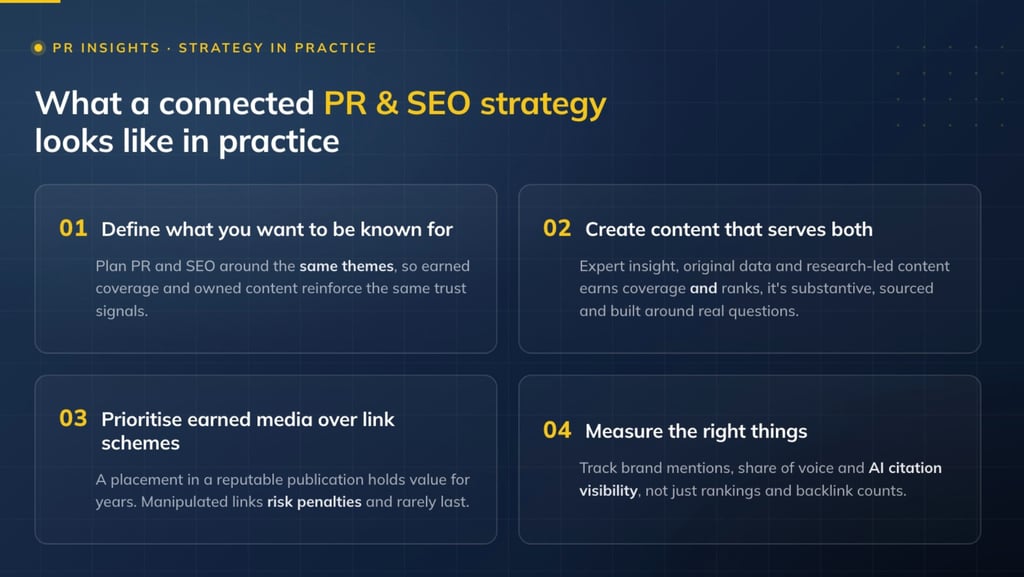
What a connected PR and SEO strategy looks like in practice
The integration is not complicated, but it does require both functions to understand what the other is trying to achieve.
Define what you want to be known for: Before planning any campaign, establish the subject areas, expertise and positioning your organisation wants to own. PR campaigns and SEO content should be planned together around the same themes, so earned coverage and owned content reinforce the same trust signals rather than pulling in different directions.
Create content that serves both journalists and search engines: Expert insight, original data and research-led content appeals to journalists because it gives them something worth writing about. It appeals to search engines and AI platforms for the same reason. It is substantive, clearly sourced and structured around real questions. The brief that produces a strong press release and the brief that produces a well-cited piece of owned content are not as different as they might appear.
Prioritise earned media over link building schemes: Paid or manipulated link building rarely delivers lasting value. Google's ability to identify and discount low-quality links has gotten sharp, and the risk of a penalty outweighs any short-term ranking benefit. A placement in a reputable publication retains its value for years and cannot be faked in the way that link schemes attempt to.
Measure the right things: Track brand mentions alongside backlinks, using tools like Google Search Console, Semrush or Brandwatch to monitor where your brand is referenced across the web. Traditional metrics like rankings, organic traffic and backlink count remain useful, but they do not tell the full story. Brand search lift, share of voice in your sector, presence in AI-generated answers and AI citation visibility come from a well-connected PR and SEO strategy.
The bottom line for PR and SEO in 2026
The brands gaining ground are not producing more coverage or chasing more rankings in isolation. They are earning placements in the sources AI systems cite, structuring owned content for extraction and measuring presence in AI-generated answers alongside reach and referral traffic.
Shared goals, content briefs that serve both journalists and search engines, a steady focus on building independent credibility and measurement that captures what the activity is achieving. That is what works now.
Author: Rob Phillimore is a Freelance public relations consultant based in Cornwall, UK, with ten years experience in B2B and enterprise PR, Marketing and Communications. For new PR consultancy enquiries, get in touch at robphillimore.com.
Frequently Asked Questions
What is the difference between PR and digital PR?
Traditional PR focuses on earning coverage and building relationships primarily through print, broadcast and mainstream online media. Digital PR applies the same principles with a specific emphasis on online publications, blogs, podcasts and communities, with search visibility as a definitive objective alongside reputation. These days, most PR activity has a digital dimension, so the distinction between the two is narrower.
Does PR replace SEO?
No. PR and SEO work best together. Technical SEO, including site speed, structured data, crawlability and page experience, remains important and is not something PR replaces. What PR provides is the authority, credibility and third-party validation that technical and content SEO alone cannot generate.
How do backlinks from PR compare to backlinks from link building schemes?
A backlink earned through genuine media coverage in a high-trust publication carries significantly more weight than a paid or manipulated link. Search engines have gotten smart at identifying low-quality links, and the penalties for participating in link schemes can be severe and long-lasting. PR-generated backlinks are also more durable. A placement in a reputable publication remains valuable for years, whereas paid link schemes carry ongoing risk as algorithm updates catch up with them.
How quickly does PR activity affect search rankings?
The impact is not immediate. PR develops authority signals over time, which feed into rankings gradually rather than producing instant results. The timeline varies by sector, existing authority level and the quality of the coverage earned, but organisations that invest consistently in PR over a twelve to twenty-four month period typically see meaningful improvements in both organic visibility and AI search presence.
Should PR and SEO teams be integrated or kept separate?
The most effective approach is to integrate planning and measurement while preserving specialist expertise. PR practitioners do not need to become technical SEO experts, and vice versa. What they do need is shared goals, shared data and regular communication so that PR campaigns inform SEO content decisions and SEO insights inform PR targeting.
What does E-E-A-T mean and why does it matter for PR?
E-E-A-T stands for Experience, Expertise, Authoritativeness and Trustworthiness, the framework Google uses to evaluate the quality and credibility of content and the sources behind it. Each of these are built through PR activity. Expert commentary establishes expertise, earned coverage in credible publications builds authoritativeness, positive brand mentions contribute to trustworthiness and demonstrated real-world experience is valued by Google's quality assessors.