
How enterprise businesses manage online reputation when AI search and deepfakes change the rules
Online reputation management (ORM) is the process of monitoring, influencing and improving how an organisation is perceived across digital platforms, including search results, review sites, social media, news coverage and AI-generated responses. ORM is a broad, cross-departmental concern for enterprise businesses in 2026, and must be treated as such, rather than be seen as a task for the communications team.
Key takeaways
AI platforms including ChatGPT, Perplexity and Google AI Overviews are now forming first impressions of your brand before any direct contact takes place
Deepfake-related incidents affected 85% of surveyed organisations in 2025, and more than half of those hit reported financial losses averaging over $280,000 per incident
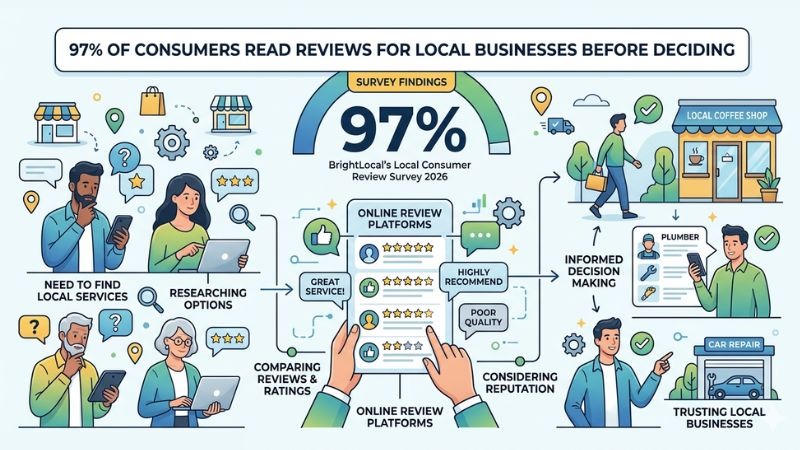
97% of consumers read online reviews for local businesses, and 80% are more likely to use a business that responds to all of its reviews
Enterprise reputation risk spans revenue, investment, talent acquisition and regulatory exposure, not just PR
No single function should own ORM alone. Cross-functional governance with clear escalation protocols is essential
AI search visibility is now a core component of any enterprise ORM strategy, not an optional add-on
What is online reputation management?
Online reputation management is often confused with public relations. While the two overlap, they are not the same. PR focuses primarily on narrative, messaging and earned media, helping to shape what journalists and publications say about you.
ORM operates across a much wider digital landscape, which, in addition to media coverage, includes search engine results, customer reviews, social media, user-generated content and how AI platforms like ChatGPT and Google AI Overviews characterise your business when a prospect researches you.
Why enterprise reputation management matters now
BrightLocal's Local Consumer Review Survey 2026 found 97% of consumers read online reviews for local businesses before making a decision. IBM's Cost of a Data Breach Report 2024 put the global average cost of a breach at $4.88 million, with lost business, post-breach customer support and regulatory response driving a year-on-year rise. That’s two commercial risks related to reputation.
Then there’s the talent dimension. Top-tier senior leadership candidates in competitive markets routinely research employer reputation through sites like Glassdoor and LinkedIn before applying. A weak employer brand removes an organisation from consideration before a single conversation takes place.
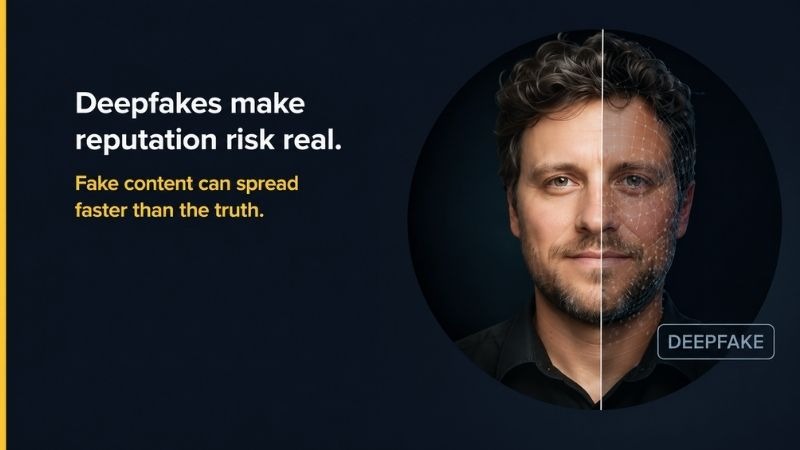
How deepfakes and AI disinformation threaten enterprise reputation
The World Economic Forum's Global Risks Report 2024 ranked misinformation and disinformation, amplified by AI, as the top short-term global risk.
IRONSCALES' Fall 2025 Threat Report, based on a survey of 500 IT professionals at organisations with 1,000-10,000 employees, found that 85% of organisations experienced at least one deepfake-related incident in the previous 12 months. 61% of those organisations reported financial losses above $100,000, while nearly 19% of the affected group lost $500,000 or more. Incidents along these lines have already hit major corporations including WPP, Ferrari and Arup.
Preparation is the single biggest predictor of how well an organisation handles a deepfake incident when one arrives. Here’s how your enterprise can prepare.
Invest in digital literacy training to equip employees with the ability to identify and report potential disinformation.
Maintain active relationships with media contacts and platform trust and safety teams who can help when genuine incidents occur.
Proactively build your reputation and develop your authentic voice to establish authority before an attack arrives, not after
Build rapid monitoring capability so that fabricated content can be identified early enough to act on rather than react to
Have a documented crisis response protocol so nobody has to make consequential decisions under pressure without a framework
What shapes your enterprise reputation online
Your online reputation is built from multiple interconnected signals. You need to understand all of them to manage any of them effectively.
Search engine results
What appears on Google SERPs (Search Engine Results Pages) shapes perception before any direct engagement takes place. Negative press, review site aggregates, competitor comparisons and autocomplete suggestions all contribute to that first impression. Most enterprise organisations underestimate how much work it takes to maintain control over this real estate, and how quickly it can shift.
Customer and client reviews
Platforms including Google Business Profile, Trustpilot and industry-specific directories carry significant weight. Trustpilot’s own research found 94% of business decision makers agree that online reviews and ratings platforms help build brand trust.
BrightLocal's 2026 survey found the average consumer now uses six different review platforms when making a decision. And volume and recency matter, with 74% of consumers only trusting reviews less than three months old. 47% won't use a business with fewer than 20 reviews.
Earned media and press coverage
Trade publications, national press and analyst reports shape how your organisation is understood by external stakeholders. A strong media presence builds third-party credibility that owned content cannot replicate. If your organisation only ever talks about itself, the people you most want to reach will notice.
Employer and executive and leadership reputation
Platforms such as Glassdoor give candidates, clients and journalists direct visibility into your internal culture, leadership and working conditions. A weak employer brand has real operational consequences: longer hiring cycles, higher salary premiums and removal from consideration before a conversation has taken place.
Your senior leaders carry the same weight. A chief executive's public statements, LinkedIn activity and conduct during controversy feed directly into how the wider organisation is perceived. Leadership reputation and employer reputation are two sides of the same coin, and both require active management.
AI-generated responses
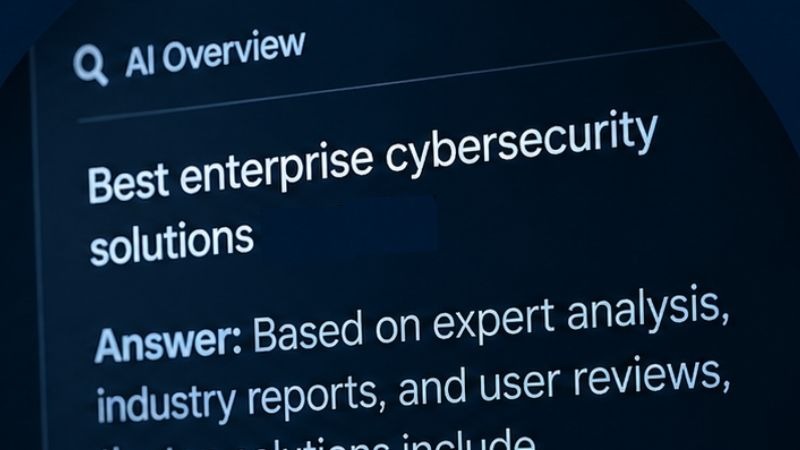
When a prospect asks ChatGPT or Perplexity about your business, sector or product, the answer they receive is shaped by everything those platforms have indexed about you.
And this answer is increasingly determining first impressions, before a prospect has visited your website or spoken to a single person in your team.
Who owns reputation management inside an enterprise organisation?
In an enterprise business, responsibility for reputation sits across multiple functions. Marketing, PR, customer service, legal and HR all have a stake in how the organisation is perceived, which can cause an issue.
When no single function has ownership, monitoring can become fragmented, response times slow and messaging uneven. For best practice, establish a cross-functional reputation management group with a designated lead, clear escalation protocols and agreed responsibilities for each function:
PR and comms own media response and narrative
Marketing owns content and channel consistency
Customer service owns review response and complaint escalation
Legal owns risk assessment and statement approval
HR owns internal communications and employer brand
Each function needs to know its role before a crisis, not during one.
Key platforms and tools for enterprise reputation management
Managing online reputation at enterprise scale requires the right technology. The platforms below have been selected for their suitability to large organisations based on capability, depth of data and real-world enterprise adoption.
Sprinklr: Monitors social media, review sites and customer service channels using AI to flag what needs attention and route it to the right team. Best for: Large organisations with multiple comms, marketing and customer service functions. Removes the need for each team to run separate tools.
Brandwatch: Tracks not just what people are saying about your brand, but how narratives are forming and evolving over time. Best for: Organisations that need to understand why sentiment is shifting, not just that it has. Particularly useful ahead of a campaign or during a reputational incident.
Meltwater: Combines press and media monitoring with social listening across news, blogs, broadcast and social in one platform. Best for: Comms teams whose reputation is closely tied to media coverage and who need to track and respond to press narratives at scale.
Talkwalker: Monitors brand mentions across text, images and video globally, with strong coverage across languages and markets. Best for: Multinationals managing reputation across multiple countries. Catches brand mentions in visual content that text-only tools miss.
Profound: Tracks how your brand is described when people ask AI tools like ChatGPT and Perplexity a question. Best for: Any enterprise serious about AI search visibility. Monitors a channel that traditional tools ignore entirely.
Semrush Enterprise AIO: Adds AI search visibility tracking to Semrush's existing SEO platform. Best for: Organisations already using Semrush for SEO who want AI visibility data without paying for a separate tool.
Google Alerts: Sends email notifications when your brand is mentioned in news or blog content. Best for: A free supplementary layer. Useful as a basic backstop but not a substitute for any of the platforms above.
How to build and maintain a positive online reputation
Building a strong reputation requires deliberate, sustained action across multiple channels. There are no shortcuts that hold up over time.
Start with a comprehensive audit
Before taking any action, establish an honest picture of where you currently stand. Search your brand name across Google, LinkedIn, Glassdoor, review platforms and AI tools. Identify gaps, inconsistencies and any negative content that has traction. Document your strengths alongside the areas that need work. This audit forms the foundation of everything that follows and should be repeated at least annually.
Define and catalogue your brand voice and values
A clear brand identity anchored in your organisation's actual values and mission must be reflected uniformly across every digital channel. At enterprise level, this means documented brand guidelines that extend to review responses, social media and press statements, not just marketing collateral.
Publish structured, authoritative content – and factor in GEO early
A strong content strategy builds credibility with your audience and populates the digital landscape with content you control. Structure it with AI discovery in mind from the start: use clear headings, direct answers, FAQ formats, well-evidenced claims and consistent entity references across all owned content. Factual, verifiable information presented this way is far more likely to be cited by ChatGPT and Google AI Overviews when prospects ask about you.
Reviews: generate them and respond to them
Positive reviews do not accumulate by accident. Request feedback from satisfied clients after a positive interaction or project completion. Email follow-ups, post-delivery prompts and direct requests from account managers are all effective techniques.
Once reviews arrive, respond to them. 80% of buyers are more likely to use a business that replies to all of its reviews, and 42% say they are unlikely to use a business that never replies. Those numbers make the case for a defined response process with clear ownership. Whoever notices a comment first is not a strategy.
How you respond to negative reviews matters as much as how often you respond. A considered, professional reply that acknowledges the issue, takes accountability where appropriate and offers to continue the conversation offline often leaves a better impression on future readers than a page of unchallenged five-star ratings.
Build your executive team's public presence
Invest in the LinkedIn profiles, thought leadership content and media visibility of your senior leaders. A leadership team that is credible, visible and actively communicating online is a substantial reputational asset to your organisation. It also provides a buffer. When a crisis hits, an executive with an established public voice has far more authority and reach than one who only appears in a statement drafted by the comms team.
Keep monitoring
Online conversations move fast and happen across more channels than most enterprise teams are tracking. A tool-supported monitoring strategy covering social media, review platforms, news, forums and AI-generated responses is your early warning system.
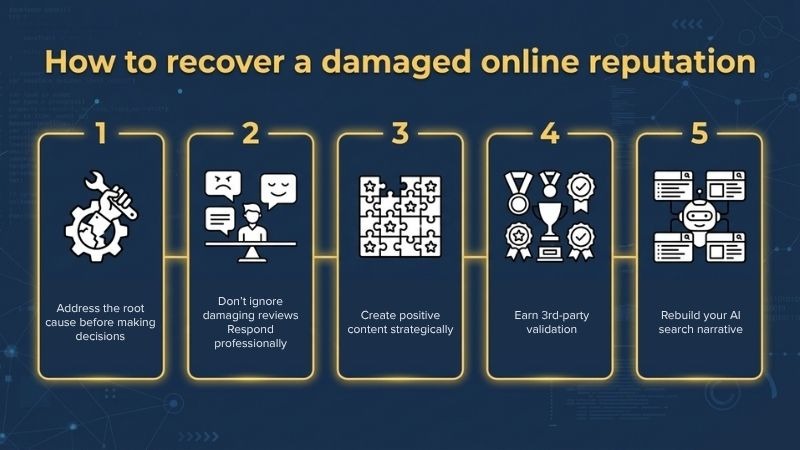
How to recover a damaged online reputation
Repairing a damaged reputation takes time, consistency, transparency and starting in the right place.
Address the root cause before making decisions
Reputation damage is frequently a symptom of an underlying operational, cultural or governance problem. Attempting to manage external perception without resolving the internal issue produces temporary results at best and amplifies the problem at worst. Start by identifying honestly what went wrong and taking visible, concrete steps to address it.
Respond to negative content directly and professionally
Do not ignore damaging reviews, critical press coverage or sustained social media complaints. Acknowledge the issue, accept responsibility where necessary, explain clearly what is being done differently and offer to continue the conversation privately. A transparent, considered response demonstrates institutional maturity.
Build positive content strategically
The most effective long-term strategy for suppressing negative search results is a sustained, substantial body of high-quality positive content. Case studies, thought leadership articles, verified client testimonials, media placements and executive commentary all contribute to pushing damaging content progressively further down the page.
Earn third-party validation
In a recovery context, independently sourced credibility carries far more weight than anything your organisation says about itself. Press coverage in credible trade and national publications, analyst endorsements, award recognitions and positive employee reviews on Glassdoor all contribute meaningfully to rebuilding stakeholder trust.
Rebuild your AI search narrative
If your brand is being described negatively or inaccurately in AI-generated responses, address the source content those platforms are drawing from. Publish factual, well-structured content that clearly articulates what your organisation does, who it serves and what distinguishes it. Earn citations from credible third-party sources. Over time, this shifts how AI platforms characterise your brand.
Measure progress with the right metrics
Reputation recovery cannot be managed without measurement. Track review scores and volume, media sentiment, share of voice in earned coverage, AI citation quality and visibility, and where possible link these to commercial metrics such as sales cycle length, conversion rates and talent acquisition outcomes. Progress will be incremental but measurable over a six to twelve month period.
The bottom line for enterprise reputation in 2026
Two changes in particular have altered what readiness looks like. AI platforms are now forming first impressions of your brand before any human at your organisation gets the chance to. And deepfake attacks have moved from niche concern to an operational reality with financial and reputational consequences most crisis plans are not built to absorb.
The organisations handling this environment well share a handful of positive habits: clear cross-functional ownership with defined escalation paths, active monitoring that extends to AI channels, visible executive voices built up before they are needed, and a crisis plan that has been rehearsed rather than filed.
Author: Rob Phillimore is a Freelance public relations consultant based in Cornwall, UK, with ten years experience in B2B and enterprise PR, Marketing and Communications. For new PR consultancy enquiries, email Rob at rob@robphillimore.com.
Frequently Asked Questions
What is the difference between online reputation management and public relations? PR focuses primarily on securing earned media coverage and shaping narrative through media relationships. ORM operates across a broader digital landscape, taking in reviews, search results, social media, employee sentiment and AI-generated responses.
How long does it take to repair a damaged online reputation? Organisations that take a sustained, multi-channel approach typically begin to see measurable improvements in review scores, search sentiment and media coverage within six to twelve months. More severe reputational damage can take much longer.
Which review platforms matter most for enterprise businesses? Google Business Profile carries the greatest weight for general search visibility. Trustpilot is widely trusted across B2B and B2C contexts in the UK. Glassdoor is the key platform for employer reputation. Industry-specific platforms vary by sector and should be identified as part of your initial reputation audit.
What should an enterprise crisis communications plan include? At a minimum it should include likely risk scenarios, designated spokespeople for each scenario, pre-approved response templates for common crisis types, defined escalation thresholds and timelines. Clear roles for each department and a process for managing internal communications alongside external ones are equally important.
How does AI search affect brand reputation management? AI platforms generate responses about brands based on content they have indexed across the web. If that content is inaccurate, outdated or negative, your reputation will be affected before any direct engagement with your organisation takes place.
How do I know if my organisation's AI search presence is accurate? Tools including Profound and Semrush Enterprise AIO allow you to monitor how your brand is described when people ask AI platforms like ChatGPT and Perplexity a question. Running regular checks across the AI tools your prospects are most likely to use is the starting point. Where inaccuracies appear, the fix is content-led: publish factual, well-structured material that gives AI platforms accurate source material to draw from.
What is the business risk of a deepfake attack? According to IRONSCALES' Fall 2025 Threat Report, 85% of surveyed organisations experienced at least one deepfake-related incident in the previous 12 months. 55% of those hit reported financial losses, with average losses standing at over $100,000 and nearly 19% of the affected group losing $500,000 or more. The reputational risk extends beyond the immediate financial loss. A convincing executive impersonation can damage client relationships, media trust and employer brand in ways that take months to address.